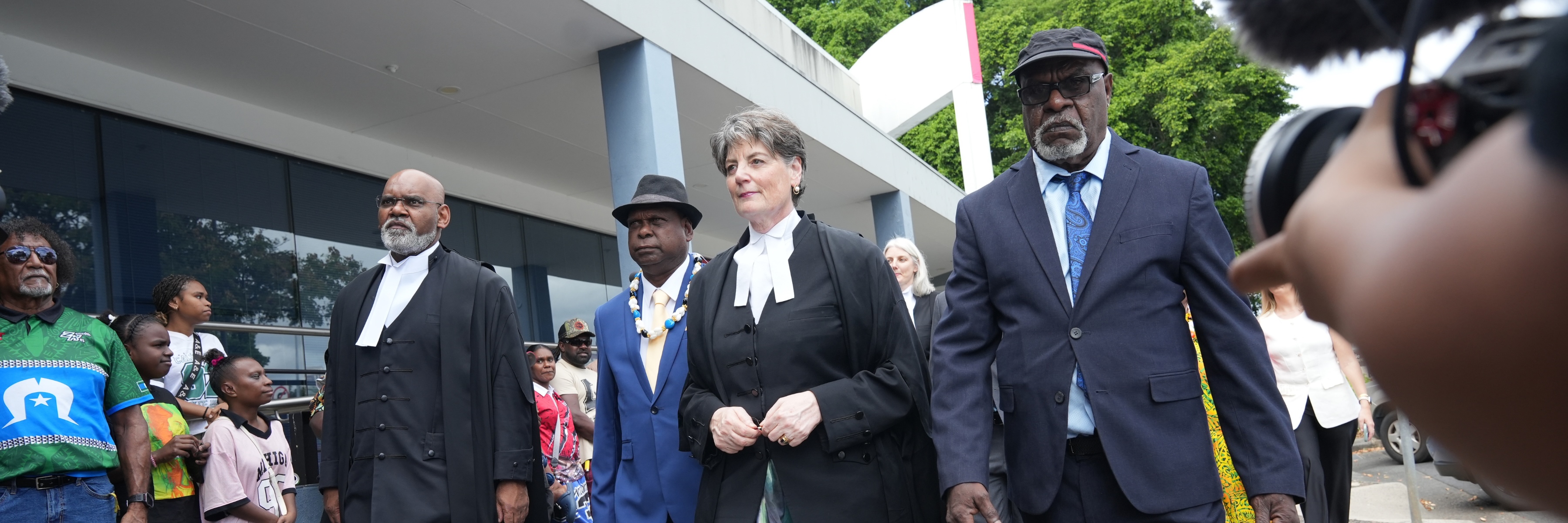
Torres Strait community leaders, Uncle Pabai Pabai and Uncle Paul Kabai, will today file an appeal in the Full Federal Court for their landmark duty of care negligence case, Pabai Pabai & Anor v Commonwealth of Australia.
In his decision handed down in July, Justice Wigney found that the Torres Strait Islands, people and culture are being “ravaged by human induced climate change” and that climate change poses “an existential threat to the whole of humanity”. He said that the Australian Government does not “currently” have a legal duty of care to protect Torres Strait people from climate harm and that it is not open to a “single judge of this Court to expand the Australian common law of negligence”.
Uncle Pabai and Uncle Paul will challenge the decision in the Full Federal Court. Their legal team will argue that the judge erred in several of his legal conclusions, and put to the court that: the Commonwealth does owe a duty of care to Torres Strait Islanders in relation to climate change; the Commonwealth’s additional emissions are a legal cause of harm to Torres Strait Islanders; and cultural harm is compensable under Australian law.
Uncle Pabai and Uncle Paul are determined to continue fighting for their communities, in the face of a government that has absconded from legal and moral responsibility and continues to put all Australian communities at risk through approvals of carbon bombs like Woodside’s North West Shelf project.
The Australian Government’s rejection of a legal duty of care to protect Torres Strait communities from climate harm, whose experience is very similar to Pacifika People, further throws the government's climate credibility into question as it attempts a last-minute diplomatic round to shore up support co-hosting COP31 with the Pacific next year.
Uncle Pabai and Uncle Paul’s case will be argued by a Counsel team headed by Craig Lenehan SC, Fiona McLeod SC and Tomo Boston KC and lawyers at Phi Finney MacDonald.
Uncle Pabai, Community leader and plaintiff, Boigu said:
“My community right now is preparing for our homes to be flooded by rising seas when the next king tides come this summer. The scientists have told us we could have less than 30 years before we lose our islands, our homes, our connection to everything. So, of course, we don’t agree with the Judge’s decision and are here, now filing an appeal. I can’t just turn away from my children and my ancestors and give up - every one of us must stand as one and do everything in our power to help.”
Uncle Paul, Community leader and plaintiff, Saibai said:
“We’ve decided we’re going to continue this fight because we don’t have a choice. We have to keep fighting, not just for our own communities - but for our brothers and sisters on the mainland, and in the Pacific, the bushfire and the flood survivors, the farmers and the school kids.
This is the greatest challenge humanity has ever faced so we have to take every opportunity to keep going. Let’s all battle this together, let’s fight climate change for our families and future generations to live on.”
Aunty McRose Elu, Seisia and Saibai Island Senior Elder said:
“Minister Bowen is in Brazil this week pushing for COP31 to be hosted in Australia with the Pacific, and while he’s shaking hands with all those heads of state and diplomats there’s a fire at home in his own backyard, and in the backyards of our brothers and sisters in the Pacific.”
“It is our destiny to continue this fight in every way we know how. We are thinking about Eddie Mabo and his journey through the courts. He suffered losses but he never gave up. Our hearts break for what we will lose, and our hearts are strong with our conviction to keep fighting. I promise you, we will not stop.”
Isabelle Reinecke, Founder and National Director, Grata.
“In other jurisdictions we have seen cases like this succeed, and here in Australia, it’s only a matter of time before the law catches up and demonstrates that it can adequately deal with negligence at a devastating scale as it has done for matters like asbestos in the past.
In fact, recently the International Court of Justice found that parties to the Paris Agreement, including Australia, have a legal obligation to set emissions targets that align with a goal of limiting global warming to 1.5°C above pre-industrial levels.”
“The Federal court also made decisive findings in the Pabai case, dispelling the smoke and mirrors that have long plagued climate change policy in this country. Australia is likely to face significant legal liability, financial cost and human toll until it brings its 2030 and 2035 target into alignment with what experts say is required; with the Climate Council recommending at least a 75% reduction in emissions by 2030 and zero by 2035.”
Brett Speigel, Principal Lawyer, Phi Finney McDonald.
“We hope that the Full Court of the Federal Court of Australia will recognise that the Commonwealth owes a duty of care to Torres Strait Islanders in relation to climate change and that the Commonwealth’s breaches of that duty of care have contributed to the harms being suffered by Uncle Pabai, Uncle Paul and other Torres Strait Islanders, including enormous cultural loss.”
MEDIA ENQUIRIES:
Please contact Belinda on 0428 805 696 or [email protected]
IMAGES/VIDEO:
Images/footage from previous court appearances and press conferences, as well as on the islands and throughout the case, are available here.
AVAILABLE FOR INTERVIEW:
- Uncle Pabai Pabai, lead plaintiff, Traditional owner and community leader, Boigu
- Uncle Paul Kabai, lead plaintiff, Traditional owner and community leader, Saibai
- Aunty McRose Elu, Torres Strait Islands Elder
- Isabelle Reinecke, founder and executive director, Grata
- Brett Spiegel, Principal Lawyer, Phi, Finney McDonald; Ben Phi, Director, Phi Finney McDonald
DECISION SUMMARY
In the case Pabai Pabai & Anor v Commonwealth of Australia, the Federal Court found that while the Torres Strait Islands, people and culture are being “ravaged by human induced climate change” and that climate change poses “an existential threat to the whole of humanity”, the Australian Government does not have a legal duty of care to protect Torres Strait people from climate harm.
Justice Wigney found that Uncle Pabai and Uncle Paul and their community proved the severe climate change harms being experienced on the Torres Strait Islands, the particular vulnerability of Torres Strait Islanders to the impacts of climate change and the inadequacy of the Australian Government’s emissions reduction targets set in 2015, 2020 and 2021.
Justice Wigney noted, “The Torres Strait Islanders are, both literally and figuratively, a world away from Canberra, the home of the Commonwealth Parliament. That is where many of the most important decisions are made about the nation’s response to climate change and its impacts. While there may have been, and perhaps still are, some climate change doubters and deniers among the politicians and bureaucrats who are responsible for making those decisions, it is tolerably clear that the Commonwealth Government has for some time known about the perils of, and ongoing risks posed by, climate change.”
Uncle Pabai and Uncle Paul had argued that loss of culture, or Ailan Kastom should be compensable. Justice Wigney, while having considerable sympathy for this argument found that the law in Australia currently does not recognise loss of culture as compensable.
Justice Wigney noted that Uncle Pabai and Uncle Paul succeeded in proving many of the factual aspects of their claim, including the scientific evidence about the devastating impacts that human-induced climate change has had, and continues to have, on the Torres Strait and Torres Strait Islanders, and their way of life.
In his judgment summary, Justice Wigney observed, “The projected future impacts of climate change in the Torres Strait Islands also paint a very bleak picture indeed. The Torres Strait Islands and their traditional inhabitants are quite literally at the very frontline of climate change and its devastating impacts. Unless something is done to arrest global warming and the resulting escalating impacts of climate change, there is a very real risk that the applicants’ worst fears will be realised and they will lose their islands, their culture and their way of life and will become, as it were, climate refugees. That would, of course, be a devastating outcome.”
Justice Wigney found that when the Commonwealth set Australia’s greenhouse gas emissions reduction targets in 2015, 2020 and 2021, the government failed to engage with or give any real or genuine consideration to what the best available science indicated was required for Australia to play its part in reducing greenhouse gas emissions and the most dangerous impacts of climate change. Justice Wigney found that the targets set by the government in those years were not based on, and were not consistent with, what the science said about the size of the emissions reduction that would be necessary for Australia to play its part in meeting the global objective of keeping global warming to 1.5°C in line with the Paris Agreement.
The Federal Court found that the Government does not owe a duty of care to Torres Strait Islanders in relation to mitigating climate harms or providing funding for adaptation measures on the Torres Strait Islands. Justice Wigney noted that the law of negligence in Australia did not allow him to find a duty of care was owed by the Government, or was breached.
Uncle Pabai, Uncle Paul, their communities and their legal team will now closely read the judgment and consider whether to lodge an appeal.
Link to summary and full judgment.
CASE BACKGROUND:
Faced with rising sea levels and distressing inaction on climate change, in October 2021 Uncle Pabai and Uncle Paul filed the Australian Climate Case against the Australian Government for failing to take reasonable steps to prevent climate change.
The homes of people in the Torres Strait could disappear beneath the rising seas, making them Australia’s first climate change refugees. For Zenadth Kes (Torres Strait islands) people, the impacts of climate change won’t only force them from their island homes, but sever their connection to thousands of years of culture and deep spiritual connection passed down generation by generation, connection to land, sea, winds and sky and community.
Uncle Pabai and Uncle Paul are seeking orders from the court that require the Federal Government to take steps to prevent this harm to their communities, including cutting greenhouse gas emissions in line with the best available science.
The Australian Government currently has a 2050 ‘net zero’ emissions target, which experts say will not be enough to prevent disaster in the Torres Strait. In fact, leading climate scientists on the Climate Targets Panel calculate that Australia’s greenhouse emissions need to be reduced by 75% by 2030 (from 2005 levels) and to net zero by 2035 to keep global heating to below 1.5°C and avert the destruction of Torres Strait Islander communities.
ADDITIONAL INFORMATION:
1. The plaintiffs
Wadhuam (Maternal Uncle) Pabai Pabai, proud Guda Maluyligal man and Traditional Owner Boigu. Wadhuam Pabai is in his 50’s and has lived on Boigu island his whole life, like generations and generations before him. He is a Director on the Prescribed Body Corporate which represents the 6 clans on the island. He is extremely concerned about the myriad of climate impacts his community is facing and is proud to be taking on this case. Wadhuam Pabai is a father of five daughters and two sons, aged between 30 and 12, and is bringing this case to ensure they and their children and their grandchildren have continuing connection to Boigu into the future.
Wadhuam (Maternal Uncle) Paul Kabai, proud Guda Maluyligal man and Traditional Owner Saibai
Wadhuam Paul is in his 50s and has lived on Saibai since he was born. He is a Director on the Prescribed Body Corporate which represents the 7 clans on the island. Wadhuam Paul is deeply concerned about his island flooding and disappearing beneath the waves. He is also worried about the effects of heatwaves and other climate impacts on people’s health. Paul is a father to two girls and six boys aged between 40 and 10 and he is bringing the case to protect their future and the future of all Saibai Islanders, Guda Maluyligal Peoples and all Australians.
2. About the case
In the class action, filed on 26 October 2021, plaintiffs Wadhuam Paul and Wadhuam Pabai are arguing that the Commonwealth has a legal ‘duty of care’ towards Torres Strait Islander Peoples, arising both from negligence law (torts) and the Torres Strait Treaty and Native Title. [Paul and Pabai] are arguing that by failing to prevent climate change the Australian Government has unlawfully breached this duty of care, because of the severe and lasting harm that climate change would cause to their communities.
This landmark case is modelled on one of the most successful climate cases in history. In 2015, environmental group the Urgenda Foundation supported 886 Dutch people to bring a case against their Government, arguing that it had a legal responsibility to reduce greenhouse gas emissions to protect them from climate change. On 24 June 2015, the District Court of The Hague ruled in favour of Urgenda and ordered the Government to cut its greenhouse gas emissions by at least 25% by the end of 2020 (compared to 1990 levels). The Government appealed, but in December 2019 the Dutch Supreme Court found in favour of Urgenda and confirmed the original court order. This led to the rapid closure of coal fired power stations and billions of euros of investment in renewable energy and energy efficiency measures.
3. Key climate harms in the Torres Strait
Zenadth Kes (the Torres Strait Islands) is the frontline of the climate crisis. Sea levels in the Torres Strait are rising at double the global average, and rose 6cm in the last decade. Without urgent action to cut greenhouse gas emissions, sea levels are projected to rise by up to one metre by 2100. The weather would become more extreme, with more intense rain in the wet season, a longer, hotter, drier dry season, more severe cyclones and more frequent and severe storms and flooding, leading to coastal erosion and inundation, which threatens freshwater supplies.
Boigu and Saibai are very flat and low-lying islands, about one and a half metres above sea level. They are particularly exposed to sea level rise – more so than many other islands in Zenadth Kes. Both islands are already being regularly flooded by sea water. This is already affecting settlements, infrastructure, important cultural sites and the gardens where people grow vegetables to feed themselves and their families.
Gudalmalulgal Kastom governs how Gudalmalulgal Peoples take responsibility for and manage their land and sea country, and how and by whom natural resources are harvested. As the ocean continues to warm, this poses a severe threat to marine life and complex systems of biodiversity, including coral reefs, turtles, dugongs and fish populations. Connection to sea country and marine hunting is integral to Gudalmalulgal Kastom. Marine hunting and fishing are also crucial food sources for Torres Strait Islander Peoples.
Irreplaceable cultural heritage and sacred sites will be completely destroyed. Inhabited and uninhabited islands are home to significant sites for ceremonies such as initiation for different clans, burial sites and locations that contain human remains and places that have as much spiritual significance as the Christian concept of heaven.
The climate crisis is a health crisis. Heatwaves are already the most deadly form of natural disaster in Australia, and climate change would bring a longer, hotter, drier dry season to the Torres Strait, in which more people become sick or die from heat-related illnesses. Malaria and dengue fever would increase because warmer temperatures and increased rainfall and flooding provide optimal breeding conditions for mosquitos.
With very limited options for adapting to climate change, many islands in Guda Maluyligal and the wider Torres Strait will become uninhabitable. Torres Strait Islander Peoples would become Australia’s first climate refugees. Being forcibly removed from their land, place and culture because of Government inaction would form another shocking chapter in Australia’s oppression of First Nations Peoples.
4. About the team
Grata advocates for a strong and functioning democracy by using circuit breaking litigation to hold the powerful to account. Grata is Australia’s first specialist non-profit strategic litigation incubator and funder. Grata develops, funds, and builds sophisticated campaign architecture around high impact, strategic litigation brought by people and communities in Australia. We focus on communities, cases and campaigns that have the potential to break systemic gridlocks across human rights, climate action and democratic freedoms.
Phi Finney McDonald is a specialist litigation firm with offices in Melbourne, Sydney and London. They practice in complex and large-scale litigation, with a focus on class actions and group litigation. Their lawyers have decades of experience seeking justice for those who have suffered loss or injury from corporate or government misconduct. Together with Urgenda, Phi Finney McDonald developed the case and have conduct of the litigation on the instructions of plaintiffs Uncle Paul and Uncle Pabai.
Fiona McLeod AO SC is a Senior Counsel at the independent Bar in Australia practising in the areas of commercial and public law matters. She represented the Commonwealth of Australia in major cases including leading the legal team in the Victorian Bushfires Royal Commission, Queensland Floods Commission and the Royal Commission into Institutional Child Sex Abuse. She has acted in other notable matters including leading the legal team representing the successful plaintiff in the Murrindindi bushfire class action and the plaintiffs in the Don Dale class action. Fiona has led the Law Council of Australia, Australian Bar Association, Victorian Bar and Australian Women Lawyers. She is the Co-Chair of the Diversity and Inclusion Council and an officer of the Bar Issues Committee of the International Bar Association and a member of the Council of the Commonwealth Lawyers Association.
Tomo Boston KC is a highly regarded trial and appellate advocate, who has advised and represented a broad range of clients in business critical litigation and regulatory investigations across a range of markets and industries. He is focused on working collaboratively with clients and solicitors to develop the most cost effective strategy to secure the best commercial and legal results while minimising legal, reputational and commercial risks. He has been recognised in The Legal 500 Asia Pacific (Commercial Disputes) and Best Lawyers in Australia.
The Urgenda Foundation is a Dutch NGO that is working to promote a fast transition towards a sustainable society. Urgenda views climate change as one of the biggest challenges of our time and looks for solutions to ensure that the earth will continue to be a safe place to live for future generations. Urgenda has helped develop the case and provided strategic and scientific support.